Fiction, both literary and populist, has always been a window into the soul of the time and place it is produced. The tone of a people's war fiction reveals their feelings about this or that contemporary conflict, a surge in dystopian fiction reveals increasing fears about the power of government and media, and so on. Through superheroes and other icons, a people's ideals and hopes for the future surface. Take the last one hundred years of American comic books for example: in the 1930s and 40s the wholesome Superman charmed the nation with his idealism and Midwestern country values; in the mid-60s the X-Men's struggle for Mutant equality through integration and peace echoed Martin Luther King, Jr's tactics in the Civil Rights Movement; and in the 2008 film Iron Man, arms dealer Tony Stark changes his company's mission from weapon development to promoting peace and developing clean and efficient energy sources. So when, in 2014, G. Willow Wilson's Ms. Marvel #1 printed 50,000 copies, outselling that month's issues of The Avengers, X-Men and even DC's Batman, those sales figures carried weight, signaling a change in what the nation, or at least its youth, wants its icons to look and act like.
The
comic follows
Kamala
Khan, a sixteen year-old Muslim Pakistani American girl, as
she becomes a super-powered vigilante and investigates the
disappearance of a number of teenagers in her home town of Jersey
City. But
in addition to finding the kidnapped, Kamala must also find her own
identity and, more importantly, accept her own identity. Identity is
everything in Ms.
Marvel,
and
Wilson
uses the tropes of the superhero genre and of the Marvel universe,
such
as costumes,
the burden of responsibility,
and genetically-granted super powers, to
explore the concept in meaningful ways. The
result is a comic that is partially about race, but also
about
feeling useless and out of place in a world that has written off its
newest generation as lazy parasites, in many cases leading young
people to believe and even fulfill this stereotype.
Both
the story and its popularity demonstrate the lost and confused nature
of the Millennial generation, and the self-reflective and
compassionate nature with which Kamala solves Jersey City's problems
as well as her own are emblematic of a paradigm shift in what
constitutes a hero.

In an interview at New York Comic Con, G. Willow Wilson said that her
priority when writing Kamala was to make her “feel like a real
girl. We didn't want to make her sort of a model minority and tell
some sort of cardboard cutout story where everybody kind of is
confined to type."
She
accomplishes this in
the very first issue by establishing Kamala's interests as things
that have nothing to do with her upbringing. She
obsesses
over and writes
fanfiction about her heroes like Captain Marvel and Iron Man, she
makes references to Dungeons
and Dragons,
and she sneaks out to a party filled with boys and alcohol in direct
defiance of her family's personal and religious boundaries. She's
naïve as well, blind to the casual racism of her classmate Zoe, who
Kamala
adores, even when Zoe asks Kamala's
friend Kiki if her parents pressured her into wearing a headscarf;
“Nobody's going to, like, honor kill you? I'm just concerned,”
she says.
A
model minority Kamala is not, but Wilson
does
not fall into “colorblindness,” the idea that race and ethnicity bring nothing
to a person's identity, and that race consciousness
is the same as racism. On
the contrary, Ms.
Marvel
uses the superhero genre as well as everyday reality to tackle ideas
of race, racism, and how these things color Kamala's perception of
herself. Zoe's
comment about 'honor killings,' for instance, expresses an awareness of the cultural perceptions of Middle Eastern people.
She
casts Kiki and, by cultural association, Kamala, as outsiders and
reminds them of their status as such, and her mention of “honor
killing” is a reminder of the specific negative connotations
attached to their culture. Even
though Kamala is, at the time, enthralled by Zoe and Kiki is merely
annoyed with her, the statement is harmful all the same, as it
reminds both girls of the way they are seen by others. Kiki's
response to Zoe, “my dad wants me to take it off. He thinks it's a
phase,” serves
as a reminder that culture and cultural decisions are more
complicated than Zoe thinks they are, and Kamala's refusal to eat
bacon on the previous page shows that although she doesn't
wear a headscarf, she isn't necessarily any less devoted to her
culture and religion than Kiki is.
These
are just three examples from the comic's first three pages, and
counting them all would be both exhausting and pointless, but
everything from Kamala's brother's intense devotion to Islam, to her
parents preventing her
from spending time with boys, to Zoe giving her alcohol as a prank,
serve as constant reminders of cultural identity, one-by-one making their mark on both the macro,
global-level understanding that the world has of Pakistan or Islam,
and the micro, personal-level understanding that Kamala has of
herself.
This
personal
understanding
is reflected in the way Kamala initially interacts with her powers,
which allow her to change her size and shape at will. When
Kamala first receives these powers, she uses them against her will
and subconsciously shifts into the form of her idol, the
blonde-haired, blue-eyed, super-powered Air Force pilot Carol
Danvers, also known as Captain Marvel, and
proceeds to save Zoe's life while
remaining in that form. It
could be argued that this transformation is the result of her
idolization and not anything deeper, but Kamala dispels this
possibility in the comic's third issue when she performs her second
act of heroism – stopping an armed robbery;
she
thinks to herself that Jersey City does not want to be saved by “a
sixteen-year-old brown girl” before transforming once again into
Captain Marvel.
Kamala's
status as an outsider is so ingrained that even when she is doing
something as noble as saving a life, she feels inadequate to do so
wearing her own face. In
essence, the questions Kamala is asking are “Can I be accepted as
myself?” and “Can I be useful as myself?” The answer to the
second question lies in her powers themselves. In addition to
changing shape, Kamala can also quickly recover from injury,
but only
if she isn't currently shape-shifting. In
other words, Kamala may be able to fight and draw attention in the
form of someone else but in order to recuperate and take care of
herself Kamala must be true to herself. This
eventually leads Kamala to get over hear fears and wear her own face
when doing the bulk of her crime-fighting.
Though
the problems Ms.
Marvel
deals with are personal, those things are often inextricably tied to
macro-level problems, especially when dealing with race and culture.
Here,
too, the comic makes use of its Marvel Universe setting to tackle
complicated issues, in
this instance through Kamala's
status as an Inhuman, a
person who is outwardly “normal,” but who has dormant alien DNA
that can be activated by a chemical called Terrigen Mists, granting
them super powers.
In
Ms.
Marvel #13,
Kamala encounters an Inhuman who calls herself Kaboom, and who is
threatening a new world order of sorts in which normal humans submit
to Inhuman rule and in which super-powered individuals
aren't seen as an “other.” This
sparks an unprecedented anger in Kamala: “There's always that one
group of people who think they have special permission to terrorize
anybody who disagrees with them. And then everybody else who looks
like them suffers.” Kamala
reacts with uncharacteristic force, badly injuring Kaboom before
running away in shame.
Though the comic never specifically mentions September 11th
or those responsible, it's
clear that Kamala's anger is directed at the attacks and the ensuing
Islamophobia,
especially considering
Inhumans
don't necessarily
look
alike. The
reaction is based in the fear that her identity as an Inhuman will be
compromised by Kaboom's actions the same way that her identities as
Pakistani and Muslim were compromised by the actions of terrorist
organizations.
The
comparison between Inhumans and Muslims doesn't end with Kaboom's
status as a symbol for Muslim terrorists, but actually functions as a
greater metaphor for the experience of being Muslim in America. Being
an Inhuman is largely an internal experience; unless their power
involves sprouting wings or claws, an Inhuman individual isn't bound
to any ethnicity or physical features. Likewise, being a Muslim is an
internal experience of a different kind – a religious one – and a
Muslim individual cannot
be picked out of a crowd without knowing more about the person. And
because Inhumans can have dormant powers, it's possible to be one
without having super powers, and it's possible to have powers without
being an Inhuman; similarly, Islam is typically associated with being
Middle Eastern, though it's both possible to be Middle Eastern
without being Muslim just as it's possible to be Muslim without being
Middle Eastern.
Most
vitally of all,
people like Kaboom use their status as an Inhuman as both a means and
an excuse to harm and oppress other people, much as Islamic
terrorists claim to use the teachings of their faith to commit
terrible acts.
Unfortunately, the
general public is bad at differentiating
those who are harmless from those who deserve
their ire, leaving
both groups ripe to be targeted by those guilty of ignorance or hate.
Kamala
is painfully aware of these similarities and the way that being
an Inhuman adds another layer to her complex identity. As
she puts it, “I'm a Pak-American, part-Alien, morphogenic nerd,”
followed by the distressing thought that she is “alone in the
universe.”
 Despite
her
deeply personal awareness of the
way others perceive her and her culture, Kamala
doesn't allow
this to shape
her identity; she neither fully
embraces the normalized American culture that
surrounds her nor fully rejects it in favor of
her family's more traditionalist Muslim and Pakistani culture. Her
morals come as much from The
Avengers as from the mosque,
her
costume is made from a burqini adorned with the lightning bolt Carol
Danvers wore on
her own costume until recently,
her
two closest friends are Bruno – a young white man – and the
religiously dedicated Kiki,
but
nowhere is this synthesis of her various identities more apparent
than in her heroic call to action. Kamala
sneaks out of her home to attend a party hosted by Zoe, but leaves in
anger when Zoe tricks her into drinking alcohol and makes fun of her
culture, assuming that by defying her parents Kamala has cast aside
her beliefs.
When
she leaves, a
chemical mist blowing through Jersey City awakens her Inhuman DNA,
briefly rendering Kamala unconscious and presenting her with
hallucinations of Iron Man, Captain America, and Captain Marvel
calling themselves “faith” and explaining to Kamala that she is
at a crossroads in her life. The
first panel of this hallucination is
an image of the heroes standing on clouds and surrounded by creatures
from Kamala's fanfiction while Captain Marvel recites
the Urdu poem “Sakal Bun” by
Amir Khusro
as Iron Man and Captain America translate it to English.
In
this surreal
image, we see Kamala's entire identity coalesce; her ideology
manifests itself in her heroes, her background in the Urdu Carol
speaks, the
bridge between them in Iron Man and Captain America's translation,
and her imagination in the creatures from her writings. The
presence of all of these things in the beginning of the next stage of
her life – the stage that will see her becoming Ms. Marvel – are
no accident. Her journey is all about identity, and here she is
seeing it manifested in a strange and abstract way, as if to say that
it is up to Kamala to make it real. Of
course, she fails in the immediate future, for when she awakens from
the hallucination she wears
the form of Carol
Danvers.
But
even still, her multi-faceted identity shines through, through the
phrase that calls her to action. It
isn't something generic, like Spider-Man's “with great power comes
great responsibility;” when Kamala sees a drunken Zoe fall into a
lake, an ayah from the Quran runs through her head: “'Whoever kills
one person, it is as if he has killed all of mankind. . .and whoever
saves one person, it is as if he has saved all of mankind.'" It
is these words that compel Kamala to action, in yet another instance
that combines her idolization of the all-American Carol Danvers with
the teachings of Islam. In
a sense, even her adoption of Carol's face contains an expression of
Kamala's identity, as she doesn't appear in Carol's Captain Marvel
costume, but her older costume from back when Carol called herself
Ms. Marvel, which Kamala prefers.
Although
she falters
and continues
to hide herself
for a time, what
makes Kamala a hero is her commitment to finding her identity on
her own terms rather
than letting the prejudice and ignorance of Zoe and America at large
define her.
Despite
her
deeply personal awareness of the
way others perceive her and her culture, Kamala
doesn't allow
this to shape
her identity; she neither fully
embraces the normalized American culture that
surrounds her nor fully rejects it in favor of
her family's more traditionalist Muslim and Pakistani culture. Her
morals come as much from The
Avengers as from the mosque,
her
costume is made from a burqini adorned with the lightning bolt Carol
Danvers wore on
her own costume until recently,
her
two closest friends are Bruno – a young white man – and the
religiously dedicated Kiki,
but
nowhere is this synthesis of her various identities more apparent
than in her heroic call to action. Kamala
sneaks out of her home to attend a party hosted by Zoe, but leaves in
anger when Zoe tricks her into drinking alcohol and makes fun of her
culture, assuming that by defying her parents Kamala has cast aside
her beliefs.
When
she leaves, a
chemical mist blowing through Jersey City awakens her Inhuman DNA,
briefly rendering Kamala unconscious and presenting her with
hallucinations of Iron Man, Captain America, and Captain Marvel
calling themselves “faith” and explaining to Kamala that she is
at a crossroads in her life. The
first panel of this hallucination is
an image of the heroes standing on clouds and surrounded by creatures
from Kamala's fanfiction while Captain Marvel recites
the Urdu poem “Sakal Bun” by
Amir Khusro
as Iron Man and Captain America translate it to English.
In
this surreal
image, we see Kamala's entire identity coalesce; her ideology
manifests itself in her heroes, her background in the Urdu Carol
speaks, the
bridge between them in Iron Man and Captain America's translation,
and her imagination in the creatures from her writings. The
presence of all of these things in the beginning of the next stage of
her life – the stage that will see her becoming Ms. Marvel – are
no accident. Her journey is all about identity, and here she is
seeing it manifested in a strange and abstract way, as if to say that
it is up to Kamala to make it real. Of
course, she fails in the immediate future, for when she awakens from
the hallucination she wears
the form of Carol
Danvers.
But
even still, her multi-faceted identity shines through, through the
phrase that calls her to action. It
isn't something generic, like Spider-Man's “with great power comes
great responsibility;” when Kamala sees a drunken Zoe fall into a
lake, an ayah from the Quran runs through her head: “'Whoever kills
one person, it is as if he has killed all of mankind. . .and whoever
saves one person, it is as if he has saved all of mankind.'" It
is these words that compel Kamala to action, in yet another instance
that combines her idolization of the all-American Carol Danvers with
the teachings of Islam. In
a sense, even her adoption of Carol's face contains an expression of
Kamala's identity, as she doesn't appear in Carol's Captain Marvel
costume, but her older costume from back when Carol called herself
Ms. Marvel, which Kamala prefers.
Although
she falters
and continues
to hide herself
for a time, what
makes Kamala a hero is her commitment to finding her identity on
her own terms rather
than letting the prejudice and ignorance of Zoe and America at large
define her.
Others,
Kamala learns, may
need help being so strong.
In
her
quest to find the missing teenagers of Jersey City, she
crosses path with The Inventor, a scientist who appears
to
be inducting teenagers into a cult of sorts through kidnapping and
behavior modification. The
kidnapped are being used as a power source for various robots and
other machines he uses to act out his schemes. When
it finally comes time for Kamala to rescue her peers and end things
with The Inventor, she makes a shocking discovery: the teens aren't
kidnapped
slaves, they're volunteers. If
they just let The Inventor use their generation as a power source,
one explains, “we wouldn't need to kill each other over oil and fry
the planet and melt the ice caps” (Wilson #10, 3), revealing
a belief that they must literally sacrifice themselves to make up for
the mistakes of the generations before them. Even
before this
point,
Ms.
Marvel
was a decidedly modern text, indicated by Kamala's interest in
fanfiction and the omnipresence of cellphones (even in the mosque),
for example.
But
it
is in this story arc, titled
“Generation Why” (issues 8-11), that
Ms.
Marvel
really establishes itself as a specifically Millennial text and
shifts
from being a comic about the racial and cultural problems of identity
facing Kamala Khan to being a comic also
about
the larger sociohistorical problem of identity facing teenagers as
a whole
in the twenty-first century.
The
very first scene of the arc has Kamala expressing her frustration
that no
adults are
aiding
her in her search for her missing peers. “Why are kids like me
always being drafted into wars we didn't start?” she asks; “This
is the kind of thing you'd think people would notice . . .That's half
of heroing. Noticing things." She
posits that adults are too wrapped up in their own problems to
involve themselves in the problems of teenagers. This
communication barrier results in a generational disconnect that is
brought up and demonstrated repeatedly throughout Ms.
Marvel.
Kamala
experiences it in her personal life with her family and Sheikh
constantly reminding her that she cannot be trusted to handle herself
around boys or alcohol, and that the past was “blessed” time,
“free from today's scandal and temptation.” The
latter idea, that the current generation is somehow lesser than those
before it, is also present at a larger scale, represented
by a repeatedly-mentioned article that Kamala's classmates must read
for school. It's
never directly quoted in the text, but when asked to comment on it in
class, Kiki says “The writer said teenagers are just parasites
addicted to their smart phones, who don't give back to society." With
adults repeating these ideas about their generation, it's no wonder
that the Millennials of Ms.
Marvel
express
an overwhelming feeling of impotence, imagining themselves as a
plague on the world rather than a cure.
But
that's not the only thing going on. Joining the Inventor's cause is
about more than just perceived worthlessness. It's
also indicative of a need for these teenagers to sacrifice and make a
martyr of themselves in order to make up for the sins of the past,
and this concept is hardly unique to Ms.
Marvel,
but rather is a trend found throughout a significant amount of
contemporary young adult fiction. The
Hunger Games trilogy,
the most recent adaptation of which was the second-highest grossing film of 2014, is perhaps the most
pervasive example. The series depicts a dystopian society in
which the majority of the population lives decadently in the The
Capitol at the expense of twelve impoverished and disenfranchised
Districts. This inequality is perpetuated in part by The Hunger
Games, in which children are forced to kill one another in order to
win glory and resources for their District. The
hero, Katniss
Everdeen, defies The Capitol at every turn and leads a revolution
against them, eventually becoming a traitor and pariah in the eyes of
those who once lauded her. Though
Katniss's gender, politics, and use of media as a weapon may be
progressive, her “lone warrior fights the battles others can't”
tale is a story as old as stories get. And
The
Hunger Games
is just one example; it's in the company of stories like Harry
Potter,
Divergent,
and Maze
Runner,
all of which depict the younger generation fighting the battles that
the older generation is either unable to or is responsible for,
placing
themselves
in dire, self-sacrificing situations to do so.
Such
novels may be noble
and inspiring, but their real-world application looks less like
Harry Potter fighting the forces of darkness, and more like the teens
of Jersey City giving up on themselves because
they think that the only thing their generation is good for is fixing
the mistakes that came before them. In
Ms.
Marvel,
the characters doing the sacrificing aren't the heroes, but the
victims.
What
makes Kamala a different, newer category of hero is that her
compassion foils
the Inventor's plans before her fists do. In
response to learning that her peers are sacrificing themselves, she
says “This is not saving the world. . .This is saying our
generation will never matter. But we have to matter. If we don't,
there's no future worth saving” (Wilson #10, 14). She goes on to
ask each individual what their hobbies and interests are, and tells
them how these things make them useful; the computer whiz can work in
cyber security, the guy who makes stuff out of junk is a future
engineer, the guy who does the jobs others won't is a future
president. Her battle with the Inventor in the subsequent issue may
save those already in
his clutches,
but it's an
act
of kindness that
connects with her peers in a personal, empathetic, and real-world way
that ensures that the villain will never have another volunteer
again. These
traits are also on display in
her battle with Kaboom. Kamala's
anger was
directed not at those who judge her, but at
the extremist Inhumans at the
root of that judgment; even in her rage Kamala is compassionate and
understanding, reinforces
her status as a modern hero. She
fights
not
those who would think ill of her or hurt her, but those
who
would hurt the people who would think ill of her.
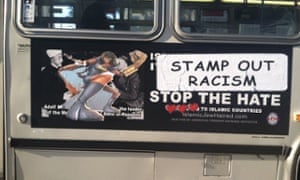
The
positive effects of Kamala's compassion extend beyond the pages of
her comic and
into the real world. In early 2015, the Freedom Defense Initiative, an anti-Islamic extremist group, bought ad space on 50 San Francisco buses, decorating them
with images of a Muslim leader consulting with Hitler and a plea to
end the aid of Middle Eastern countries. A
group of street artists called Bay Area Art Queers Unleashing Power
promptly painted over these ads with images of Kamala Khan alongside
quotes including “Stamp Out Racism” and “Free
Speech Isn’t a License to Spread Hate”. That
her message and
image are
seen
as
fit
to fight real-world bigotry
speaks volumes about her impact. Yes,
this is just one incident and one group of artists, but for them to
choose Kamala over the dozens of more popular heroes or even real
Muslim leaders expresses a belief that the character carries weight
and can exist as a symbol for positivity and acceptance. Though
she may be a successful comic book character, she is as of now a
relatively small blip on the radar of popular culture, but her
success within her industry and ability to inspire fans is indicative
of an audience that wants to
see their
heroes be as colorful and as diverse as they are, and
one that reacts powerfully when they do.
That
alone may be enough to prove that Kamala represents a paradigm shift
in the nature of what constitutes a hero, but there's more than that.
She's significant and touching not only because she's female, Middle
Eastern, and still selling comics, but
because she represents the internal struggle of a relatively new
generation of children and young adults. In
addition to mad scientists, rogue Inhumans, and giant alligators,
Kamala's battles are those of the modern world, and her weapons are
compassion and understanding, the tools of the modern hero. It
isn't enough anymore to beat up a problem and call it done, and G.
Willow Wilson seems
to know
this; the hero must understand villains
and their victims, and not
merely vanquish the evil, but create
a world in which it is more difficult for evil
to
emerge
in the first place.
Ms.
Marvel
recognizes that finding identity and
worth
in a world that feels increasingly troubled and
overpopulated is
difficult, and
that the burden of peers and elders can make young people feel torn
and useless,
but Kamala Khan reminds us that we are never useless. As she says,
“giving up on the next generation is like giving up on the future,”
and she encourages the young and the old alike to never let that
happen.

No comments:
Post a Comment